sexta-feira, novembro 24, 2006
14 de Dezembro - 3 e ultima conferencia
A 14 de Dezembro de 2006 fechamos o 1 ciclo de conferencias viagens na minha Terra. Tiago Salazar, jornalista do Correio da Manhã, Rotas e Destinos, e cronista da revistas Artes vai proferir a sua conferencia com o titulo Indigenas, retratos falados.


2 Conferencia - viagens na minha Terra

Sandra Nobre, jornalista do Sol foi a segunda conferencista do ciclo viagens da minha Terra, um projecto da Europa Viva numa parceria com a Faculdade de Letras da Universidade de Lisboa (licenciatura de Estudos Europeus).
A estrutura da conferencia da Sandra Nobre assentou na desconstrução do jornalista de viagens, e por outro lado, colocou em análise o trabalho produzido pelos jornalistas desta área de comunicação.
Falou ainda do modo deficiente como Portugal promove a sua imagem (relativamente a qualquer outro país da Europa), e denunciou os poucos projectos culturais que existem na área das viagens em torno do património material e imaterial de Portugal.
9 Dezembro - Encontro Casa da Memória
Apostamos na data de 9 de Dezembro para o lançamento do projecto A Casa da Memória. O programa é exactamente o mesmo.
O encontro será ás 9:45 na porta principal do Parque da Liberdade, vila de Sintra.
O encontro será ás 9:45 na porta principal do Parque da Liberdade, vila de Sintra.
Encontro Casa da Memória - cancelado
Por motivos que se prendem com o estado do tempo em Portugal, decidimos cancelar o nosso encontro que precisava (e precisa) de muito sol e muita luz.
terça-feira, novembro 21, 2006
25 de Novembro - Casa da Memória
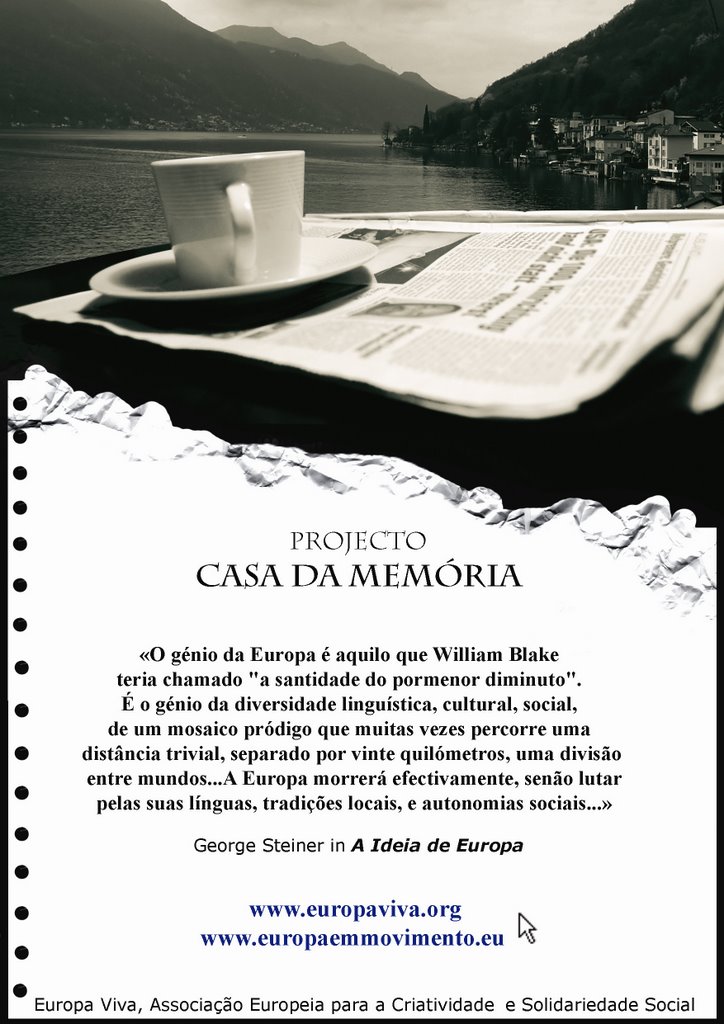
Programa:
Local do encontro:
Sintra - Vila - Parque da Liberdade (entrada principal)
10:00 workshop fotografia
12:00 almoço (cada um leva o seu almoço)
14:00 electrico Praia das Maçãs
15:00 passeio pedestre Praia das Maçãs / Cabo da Roca
17:00 encerramento
Contactos 96 565 38 34
segunda-feira, novembro 20, 2006
Conference “A Soul for Europe” - Jose Durão Barroso
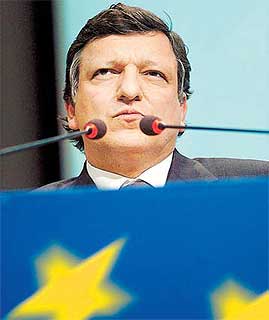 Conference “A Soul for Europe”Berlin, 17 November 2006
Presidents,
Ladies and Gentlemen,
It is a great pleasure for me to join you at this Berlin Conference on “A Soul for Europe”.
Some people tell me that a President of the European Commission should not speak about culture, an area where the main competence remains at the national and regional level. I disagree. The European Commission by definition is the institution par excellence to represent the European interest, and I find it impossible not to talk about something so central to Europe as culture and its meaning for us. So I am determined to speak up for, and highlight, the cultural dimension of Europe. And this conference is an excellent occasion to do so.
My thoughts turned to this gathering when I heard that Anna Politovskaïa had been assassinated. The murder of this brave journalist is just one example of an increasing number of challenges to European values. Values like freedom of speech, freedom of the press, and tolerance. So my intention today in Berlin, the heart of Europe, is to issue a wake-up call in the defence and preservation of our values. We need to defend the European spirit of freedom.
With world events unfolding as they are, I feel that it is our duty, as politicians but also as individuals, to say today that the European values which bind together our continent and our common project – freedom, humanism and tolerance – are being challenged. I should also make it clear to you all, as movers and actors in the world of culture, that, in the defence of its values and in the fight for its values, Europe needs you!
Europe needs culture since culture, without any doubt, contributes to its well-being, its greater welfare and its social cohesion. But, beyond that, Europe needs culture in order to proclaim, at this time of instability, that our values are not negotiable.
Europe needs everyone who regards our values and our culture as the fundamental bases of our society. Our values, especially freedom, constitute the "European spirit" around which Europe is being constructed. For Europe is also an eminently cultural invention. It has consciously opted to rise above national, regional and local identities, even while respecting them, and to bring its peoples together by focusing on the common references to their deep roots. European identity is about diversity. And the way we integrate that diversity cannot be based on exclusive identities, but on common values. Yes, deep roots are important, but it is also important to recognise that modern Europeans are grafted onto many different roots, based on the many different peoples and cultures that came before us. In other words, European identity is not based on territories or ethnicity, but on shared values and culture. Europe gave the world humanism and democracy, to both of which it remains profoundly attached. But the novelty of the European project lies in the fact that respect for diversity – in terms of history, language and culture – is at the very core of Europe’s culture and is its natural expression.
The contribution made by culture to the defence of this diversity and to this spirit of openness, which are our most precious assets, is, to my mind, more necessary than ever.
Globalisation could generate among some Europeans a sense of alienation and even a sense of loss of identity. This should not happen. Europe must respond. And the best response it can give is to preserve its values. By equipping itself to confront the new forms of competition on the world market and by calling on its human capital and its knowledge, Europe can endow itself with the means of constructing a European society that is dynamic, creative and open. Above all, it is by adapting to change that Europe will be able to remain true to its values.
It is in this sense, perhaps more than any other, that culture plays a key role in the "European pact". Culture is the place where creativity most fully expresses itself, and it is a force for innovation and initiative. It is also a vehicle for social integration and hence for social cohesion. Lastly, culture promotes a sense of belonging while paving the way for a plurality of identities.
Culture carries real economic weight. It contributes to wealth creation. It creates new jobs. It contributes to innovation, the spirit of enterprise and knowledge. A recent report commissioned by the EU shows that 2.6% of its GDP comes from cultural activities – an enormous amount, in real terms. This is why I do not regard as sacrilegious the idea that culture and creation can stimulate Europe's economic and social success. I do not see anything taboo in the idea that the cultural economy can also contribute to European integration.
Culture also plays an active role in giving fresh impetus to the European Union through local development. Creative activities, which often have a strong territorial dimension, do not always lend themselves well to relocation. Though, even here, Europe must be capable of holding on to its creative workers, who, like scientific researchers, might be tempted to go elsewhere in a quest for better conditions.
Apart from territorial cohesion, culture is, as I have already said, a factor for social cohesion. Cultural activities are among the valuable means of building an "inclusive Europe". Culture is an essential factor of human development. It improves the living conditions of vulnerable categories among the population, of young people in difficulty and of those who endure poverty or insecurity. In these times of rootlessness and growing solitude, culture provides a link to society at large.
By forging links between individuals, culture can influence their participation in collective life. It is from culture that the sense of a shared destiny transcending the diversity of origins and languages springs. It is the weft around which the rich tapestry of values is woven. Culture, then, is the keystone of the sense of belonging and of active citizenship that Europe needs. By facilitating dialogue, culture opens the way to development in an increasingly multicultural and multilingual society.
For all the reasons I have mentioned – and about which, I am sure, the Commissioners participating in the conference will talk in greater detail, I see a greater need than ever before to emphasise the cultural dimension of Europe, and to involve young people fully in the project. This is a message to everybody, to artists and intellectuals, to political decision-makers, and to civil society.
Events in the world today should impress on us a sense of urgency.
Let me return to my main point today. Throughout the world we see fanaticism on the rise. Throughout the world we hear the mutterings of fundamentalisms. Throughout the world we sense that intolerance is taking a stronger hold. Let us not hide the truth. Let us face up with the utmost resolution to the dangers that threaten our freedom and our values. Europe, which "invented" tolerance for individuals, for their opinions, for their beliefs and for their differences, must make its own special voice heard. Let us not hesitate and then one day regret that we did not say "no" in time and out loud.
So it is important to defend respect for diversity. But at the same time we must not lose sight of the fact that this respect is based on a deeper respect for certain principles which cannot be negotiated. Freedom of expression, freedom of religion, or the right not to be religious, and freedom of creation are simply not negotiable.
A serious threat today is self-censorship. When we start anticipating reactions, and telling journalists, and artistic and cultural creators that they have to show prudence, we are de facto narrowing the space of freedom.
There is also a risk that we take such disproportionate action in the interests of greater security that we also narrow the space of freedom. We cannot lose our soul in the struggle against terrorism. Putting our liberty in danger in this way would be a victory for terrorism.
A saying attributed to the great American statesman Benjamin Franklin sums it up well: 'Any society that would give up a little liberty to gain a little security will deserve neither and lose both.'
Ladies and Gentlemen,
Europe evokes for me an image. An image of Europe seen as a shared home. As Edmund Burke said in the eighteenth century: “No citizen of Europe could altogether be an exile in any part of it.” Europe is a large house that has been inhabited by a variety of different populations since time immemorial. A place for living and sharing together where tolerance has emerged quite naturally. The German philosopher Husserl put it magnificently when he said that the nations of Europe have “a special inner affinity of spirit that permeates all of them and transcends their national differences. It is a sort of fraternal relationship that gives us the consciousness of being at home in this circle.”
At the beginning of the 21st century, we should, all together, reinforce the foundations of our European home. Which means preserve and reinforce our values. Defend freedom of thought. Defend freedom of speech. Defend freedom of creation. Let us never accept that a book should not be published, that a caricature should be censured or that an opera should be kept off the stage!
Together, let us defend cultural pluralism and the diversity of cultural expression. Together, let us defend multilingualism, one of the inviolable principles of European integration, and a better understanding between language communities. Let us encourage language learning and the translation of works of European literature, which would enrich us all.
Together, let us defend the freedom to create new musical works, new films and audiovisual works, the plastic arts and the performing arts.
Together, let us defend freedom through dialogue between cultures, in Europe and the wider world. Let us listen. Let us offer a hand. But let us also assert that, as Europeans, we place our democratic values above everything else.
Together, let us defend freedom by asserting the right to dream and imagine in a Europe that is reconciled in democracy, tolerance and peace.
Let us never allow our guard to drop or take anything for granted. I'll return to Edmund Husserl and give him the last word. In a speech in Vienna in 1935, as Europe was heading towards its darkest hour, he said: "Die Krise des europäischen Daseins hat nur zwei Auswege: den Untergang Europas in der Entfremdung gegen seinen eigenen rationalen Lebenssinn, den Verfall in Geistfeindschaft und Barbarei, oder die Wiedergeburt Europas aus dem Geiste der Philosophie, durch einen ... Heroismus der Vernunft."*
Let every one of us, each in our own place, make our own contribution to this heroism of reason so that history – both that of Europe and that of the world – is never again given any opportunity to repeat its past mistakes.
Thank you.
* (The crisis of European existence can end in only one of two ways: in the ruin of a Europe alienated from its rational sense of life, fallen into a barbarian hatred of spirit; or in the rebirth of Europe from the spirit of philosophy, through a heroism of reason) (Edmund Husserl, "Die Philosophie in der Krisis der europäischen Menscheit", 3.10.1935.)
Shostakovich - Moscovo
Nota da direcção:
Por razões logisticas a Europa Viva e o programa Ritornelo decidiram cancelar a viagem a Moscovo no proximo mês de Dezembro, e integrar os viajantes de Shostakovich II no itinerário Comboio de Ana Kerenina em Maio de 2007.
Por razões logisticas a Europa Viva e o programa Ritornelo decidiram cancelar a viagem a Moscovo no proximo mês de Dezembro, e integrar os viajantes de Shostakovich II no itinerário Comboio de Ana Kerenina em Maio de 2007.
sábado, novembro 11, 2006

Rota da Memória - Julho de 2007


O século XX ficará na geografia da memória europeia como um dos séculos mais trágicos da história da humanidade.
O projecto Europa em Movimento vai lançar em Julho de 2007 o primeiro troço das rotas da memória, um programa dedicado aos Totalitarismos do Século XX. Vamos aos Gulags da nossa história recente.
Para que o projecto se torne logisticamente exequivel vamos começar pelo troço Moscovo - Beijing; isso mesmo, vamos fazer o trans mongoliano, isto é, uma das três linhas possiveis que unem a Europa á Ásia.
Depois seguir-se-ao outros topogramas (cuja calendarização estamos a preparar). Faremos Madrid, Berlim, Varsóvia...
Para os sócios e amigos do Clube Europa Viva que quiserem participar neste projecto, aqui fica um conselho: começem desde já a preparar-se.
Leiam antes de mais o - Arquipélago Gulag, um livro de Alexandre Soljenitsin, e os Cisnes Selvagens - Três Filhas da China de Jung Chang.
sexta-feira, novembro 10, 2006
Encontro casa da memória - 25 de Novembro 2006
 Urge decidir sobre a nossa participação no encontro de 25 de Novembro.
Caros sócios fundadores, sócios em geral, e dirigentes Europa Viva aguardamos as vossas inscrições, o mais rápido possivel.
quinta-feira, novembro 09, 2006

Caros sócios, caros membros do Clube Europa Viva, caros amigos:
No proximo dia 25 de Novembro a Europa Viva lançará publicamente mais uma iniciativa, desta feita relacionada com o projecto A Casa da Memória, onde serão trabalhados dois dos mais importantes factores de identidade europeia, segundo George Steiner, os cafés e os passeios a pé tal como escreveu no livro Que Europa?.
Para começar a trabalhar o projecto, a Europa Viva propôs a dois jovens artistas plásticos, ambos dedicados á fotografia, que ministrassem aos sócios e amigos da Europa Viva um workshop de fotografia, onde todos pudessemos «aprender» não apenas os conteúdos da sua linguagem, mas também o abc das técnicas.
O Cristovão, conhecido fotografo português, aceitou de imediato o convite e estendeu-o a um outro artista que anuiu o projecto.
Assim, no próximo dia 25 de Novembro, ás 10:00 em Sintra, na porta principal do Parque das Merendas, iniciamos o workshop, seguido de um almoço fugral e de um passeio que vai de Sintra ao Cabo da Roca. A primeira etapa do «passeio» será feita de electrico até á praia das maçãs. A segunda etapa far-se-á a pé - até ao Cabo da Roca. É um passeio breve, tem a duração de 2 horas aproximadamente, e é de dificuldade transversal a todos os grupos etários.
Os pormenores desta iniciativa ser-vos-ão dados á medida que o projecto se for concretizando. A iniciativa está aberta a todos os que queiram participar. Os nossos amigos e até familiares. A ideia é aproveitarmos ao máximo o gesto generoso destes dois artistas.
O guia, percebendo as nossas motivações, foi parco a fazer-se cobrar. Leva apenas 10€ pelo itinerário. Em relação ao almoço convido-vos a prepararem a lancheira e partilharmos um lugar bonito ali mesmo no Parque das Merendas.
A condição da participação é esta: ser portador de uma maquina fotográfica, ter lido de preferencia o livro Que Europa de George Steiner, e preparar-mo-nos para um concurso de fotografia cujo tema são cafés.
No dia 25 de Novembro de 2007, algures em Lisboa, a Europa Viva porá de pé a sua primeira exposição de fotografia, comissariada pelo Cristovão. O vencedor do tema cafés, juntar-se-á a 10 outros jovens talentos (fotógrafos) numa mostra intitulada - memória e identidades.
terça-feira, novembro 07, 2006
25 de Novembro - encontro de fotografia Europa Viva - Casa da Memória
 O Gonçalo, o tal guia da nossa «mega festa aniversário» preparou-nos um «caminho» para o 25 de Novembro muito interessante. É na zona de Cascais - Sintra. Tem a vantagem de logisticamente corresponder melhor aos nossos objectivos. E consiste no seguinte:
- apanhamos o electrico em Sintra (Olga Cadaval) até á Praia das Maçã, e daí iniciamos a caminhada até ao Cabo da Roca.
O percurso tem a duração de 2 horas e um grau de dificuldade acessivel.
domingo, novembro 05, 2006
25 de Novembro - encontro de fotografia Europa Viva - Casa da Memória
O guia que nos acompanhou aquando a nossa magna festa (aniversário Europa Viva) entusiasmou-se com os conteúdos do nosso encontro (fotografia - casa da memoria) e pediu que o deixámos pensar um itinerário especial para o dia 25 de Novembro.
A ideia incial era irmos a Montemor: lá encontrariamos caminhos muito belos, cafés muito tipicos, e tascas espantosas para almoçarmos. os ingredientes necessários para lançar o projecto Casa da Memória - fotografia.
O Gonçalo não trabalha aquela zona territorial mas quis tanto participar no nosso projecto que pediu o que deixássemos propor uma alternativa à nossa ideia.
Ficamos então à espera....pode ser que nos encontremos ainda mais perto de Lisboa...
A ideia incial era irmos a Montemor: lá encontrariamos caminhos muito belos, cafés muito tipicos, e tascas espantosas para almoçarmos. os ingredientes necessários para lançar o projecto Casa da Memória - fotografia.
O Gonçalo não trabalha aquela zona territorial mas quis tanto participar no nosso projecto que pediu o que deixássemos propor uma alternativa à nossa ideia.
Ficamos então à espera....pode ser que nos encontremos ainda mais perto de Lisboa...
sexta-feira, novembro 03, 2006
Conferencias - Faculdade de Letras
Estão confirmadas as duas próximas conferencias do Ciclo viagens na minha Terra.
Calendário:
23 de Novembro - 18:00 Anfiteatro III - Faculdade de Letras - Sandra Nobre - jornal Sol
Dia 14 de Dezembro - 18:00 Anfiteatro III - Faculdade de Letras - Tiago Salazar - jornal Correio da Manhã, revista - Rotas e Destinos.
Calendário:
23 de Novembro - 18:00 Anfiteatro III - Faculdade de Letras - Sandra Nobre - jornal Sol
Dia 14 de Dezembro - 18:00 Anfiteatro III - Faculdade de Letras - Tiago Salazar - jornal Correio da Manhã, revista - Rotas e Destinos.
quinta-feira, novembro 02, 2006
correio - moscovo

«Desejo manifestar-lhe o meu sincero agradecimento pela nossa viagem a Moscovo, que teve beleza, espiritualidade, magia e bom humor».
Carlos Macedo
terça-feira, outubro 31, 2006
Imagem Blog
Estamos a trabalhar na personalização do Blog. Pedimos desculpa pelo desconforto imagético que temos provocado aos nossos leitores.
Casa da Memória - 25 de Novembro - Alentejo
Caros sócios fundadores, associados, e amigos:
A Europa Viva vai lançar o projecto Casa da Memória no proximo dia 25 de Novembro, sábado, em Montemor (brevemente daremos mais informações sobre esta actividade - por agora fica o anúncio para reservarem este dia, se assim o entenderem, obviamente).
Trata-se de um lançamento (muito) especial: partindo do pensamento de George Steiner trabalhado no livro "A Ideia de Europa", onde o autor escreve:
- «A Europa é feita de cafés e cafetarias...Desenhe-se o mapa das cafetarias e obter-se-á um dos marcadores essenciais da ideia de Europa...», escreveu Steiner.
- «A Europa foi e é percorrida a pé. Isto é fundamental. A cartografia da Europa é determinada pela capacidades, pelos horizontes percepcionados dos pés dos humanos...», diz ainda Steiner;
A Europa Viva vai realizar um passeio a pé pelas terras do Alentejo, onde será ministrado um curso de fotografia (que outra linguagem criativa trabalhará tão intensamente a memória?) por dois fotojornalistas profissionais, de modo a podermos começar a fotografar ainda no Alentejo, os cafés europeus. E, claro, os nossos pés...
Sobre este lançamento vamos falando nos proximos post.
A Europa Viva vai lançar o projecto Casa da Memória no proximo dia 25 de Novembro, sábado, em Montemor (brevemente daremos mais informações sobre esta actividade - por agora fica o anúncio para reservarem este dia, se assim o entenderem, obviamente).
Trata-se de um lançamento (muito) especial: partindo do pensamento de George Steiner trabalhado no livro "A Ideia de Europa", onde o autor escreve:
- «A Europa é feita de cafés e cafetarias...Desenhe-se o mapa das cafetarias e obter-se-á um dos marcadores essenciais da ideia de Europa...», escreveu Steiner.
- «A Europa foi e é percorrida a pé. Isto é fundamental. A cartografia da Europa é determinada pela capacidades, pelos horizontes percepcionados dos pés dos humanos...», diz ainda Steiner;
A Europa Viva vai realizar um passeio a pé pelas terras do Alentejo, onde será ministrado um curso de fotografia (que outra linguagem criativa trabalhará tão intensamente a memória?) por dois fotojornalistas profissionais, de modo a podermos começar a fotografar ainda no Alentejo, os cafés europeus. E, claro, os nossos pés...
Sobre este lançamento vamos falando nos proximos post.
segunda-feira, outubro 30, 2006
Idomeneo - 5 e 8 Novembro - Berlim
Idomeneo, ópera «censurada» de Mozart, volta aos palcos a 5, 6, 7 e 8 de Novembro pela Deutsche Oper em Berlim.
sexta-feira, outubro 27, 2006
1ª Conferencia viagens na minha Terra
Legenda da fotografia: Luis Maio e Teresa Alves (directora da Licenciatura de Estudos Europeus da FL)
Luis Maio, jornalista do Público (Fugas) foi o primeiro conferencista do ciclo de conferencias viagens da minha Terra - 2006.10.26 - Faculdade de Letras da Universidade de Lisboa.
Participaram nesta conferencias: alunos da licenciatura de Estudos Europeus, Professores, sócios e membros do Clube Europa Viva.
Foi uma conferencia propositadamente polémica. Luis Maio começou por decretar a falência da viagem como caminho para a descoberta do «novo» e o triunfo do turismo, meio massificado, e industrializado de viajar.
Sobretudo os alunos e professores alimentaram com o conferencista uma intensa polémica baseada no facto de a viagem, ainda que a locais já descobertos e até massificados pelos media poder constituir para o viajante um momento de encontro com o «outro» pleno de sentido e saber.
Continuamos a discutir a narrativa de viagens com a jornalista Sandra Nobre no próximo dia 23 de Novembro às 18h na Faculdade de Letras.

Luis Maio, jornalista do Público (Fugas) foi o primeiro conferencista do ciclo de conferencias viagens da minha Terra - 2006.10.26 - Faculdade de Letras da Universidade de Lisboa.
Participaram nesta conferencias: alunos da licenciatura de Estudos Europeus, Professores, sócios e membros do Clube Europa Viva.
Foi uma conferencia propositadamente polémica. Luis Maio começou por decretar a falência da viagem como caminho para a descoberta do «novo» e o triunfo do turismo, meio massificado, e industrializado de viajar.
Sobretudo os alunos e professores alimentaram com o conferencista uma intensa polémica baseada no facto de a viagem, ainda que a locais já descobertos e até massificados pelos media poder constituir para o viajante um momento de encontro com o «outro» pleno de sentido e saber.
Continuamos a discutir a narrativa de viagens com a jornalista Sandra Nobre no próximo dia 23 de Novembro às 18h na Faculdade de Letras.
Subscrever:
Mensagens (Atom)